Ricoh GR III Flash: GF-2, P-TTL Options and Best Settings
Quick answer
The Ricoh GR III has no built-in flash, so you need a hot-shoe unit. The best one is Ricoh's GF-2: it weighs about 19 g and, since firmware 2.10 (GR III) or 1.60 (GR IIIx), gets its own GF-2 Flash Mode that sets exposure from the focus distance. Keep ISO on Auto and stay within about 2 meters. If you need more power or bounce, use a P-TTL flash such as the Pentax AF180FG.
The Ricoh GR III has no flash in the body. Ricoh's own specification page lists a hot shoe "compatible with P-TTL Auto Flash" and nothing else, which was one of the trade-offs of shrinking the camera after the GR II. If you want the hard, direct-flash look on night streets, or simply some fill light at a dinner table, you have to put something on top.
The good news is that the choice got much easier in October 2025. Ricoh's tiny GF-2 flash, launched for the GR IV, now has a dedicated exposure mode on the GR III and GR IIIx. This guide covers which flash to buy, the firmware you need, how far each option actually reaches, and the settings we would use. A plain note on method: it is a spec- and settings-based guide built from Ricoh's official product, accessory and firmware pages plus the GF-2 launch coverage, all read on October 9, 2026. We are not reporting hands-on tests of the GF-2.
Does the Ricoh GR III have a flash?
No. The GR III, GR IIIx and their special editions all rely on the hot shoe. Here is what the camera itself supports, straight from Ricoh's GR III/GR IIIx spec page:
| Flash feature | GR III / GR IIIx |
|---|---|
| Built-in flash | None |
| Hot shoe | Yes, P-TTL auto flash compatible |
| Flash modes | Flash On, Flash On+Red-eye, Slow-speed Sync, Slow Sync+Red-eye |
| Flash exposure compensation | -2.0 to +1.0 EV |
| Shutter speed range | 1/4000 to 30 sec (1/2500 sec max at f/2.8) |
That last line matters more than it looks. At f/2.8 the shutter tops out at 1/2500 sec, and you only get the full 1/4000 sec from f/5.6. For daylight fill flash, stopping down a little gives you more room before highlights clip.
If a body flash is a deal-breaker, the GR II still has one, and our GR II buying guide explains when that older camera makes sense.
The flashes that work on the GR III
Ricoh lists four flashes on its GR III/GR IIIx accessory page, and its firmware notes name two more Pentax units for P-TTL. These are the ones worth knowing:
| Flash | Guide number on GR III | Power | Status (Ricoh, Oct 2026) | Best for |
|---|---|---|---|---|
| Ricoh GF-2 | 3 (ISO 100, m) | Built-in Li-ion, USB-C | Current | Street, parties, pocket carry |
| Pentax AF180FG | 18 (ISO 100, m) | 2x AAA | Current | Events, bounce |
| Pentax AF201FG | 20 (ISO 100, m) | 2x AAA | Discontinued | Used market only |
| Pentax AF540FGZ II | 35 (ISO 100, m, 28mm zoom) | 4x AA | Discontinued | Overkill on a GR |
The firmware notes also list the AF540FGZ, AF360FGZ and AF360FGZ II as P-TTL compatible, which helps if you already own a Pentax kit.
Our pick: the GF-2 for almost everyone. A GR is a pocket camera, and the GF-2 is the only option here that keeps it that way. Buy the AF180FG only if you shoot events indoors and want to bounce light off a ceiling.
The Ricoh GF-2: specs and what changed with firmware 2.10
Ricoh announced the GF-2 alongside the GR IV. According to photoscala's launch report of August 28, 2025, which quotes Ricoh's specifications:
| GF-2 spec | Value |
|---|---|
| Guide number | 3 (ISO 100), 6 (ISO 400) |
| Weight | About 19 g |
| Flashes per charge | About 270 |
| Recycle time | About 2 seconds |
| Charging time | About 2 hours, over USB-C |
| Coverage | Optimized for an 18mm focal length; vignettes with the GW-4 wide converter |
| Launch price | Around 100 euros |
At launch, the GF-2 was not a full partner for the GR III. Photoscala reported that on GR models other than the GR IV it only fired in full-discharge mode, because the flash contacts are laid out differently, and that a firmware fix was planned for October 2025.
That fix arrived on October 23, 2025: firmware 2.10 for the GR III, Street Edition, Diary Edition and HDF, and 1.60 for the GR IIIx, Urban Edition and GR IIIx HDF. Both add a new exposure mode, GF-2 Flash Mode. Ricoh's notes describe how it works:
- The camera "automatically calculates the appropriate exposure value before shooting, based on the subject distance measured by autofocus or the distance set manually via manual focus."
- It is available when the mode dial is on P, Av, Tv or M, and can be assigned to the ADJ lever or an Fn button.
- It does not work for video or with Snap Distance Priority.
- The camera waits for the flash to recharge before each frame, so continuous and bracket shooting slow to about one frame every two seconds.
- With a fixed ISO, Ricoh warns that the camera's ability to adjust exposure is limited and frames may come out over- or underexposed.
The GR IV page adds a detail that explains that last warning: with ISO Auto, the system adjusts both the flash output and ISO to the distance; with fixed ISO, it can only change the flash output. A guide number of 3 leaves very little room, so give the camera ISO as its second lever. If you also shoot a GR IV, our GR IV accessories guide covers which flash and hot shoe gear carries over.
How far a small flash really reaches
Guide number divided by aperture gives the maximum flash distance in meters. Every two stops of ISO doubles the guide number. Applied to the GF-2:
| ISO | Effective GN | Range at f/2.8 | Range at f/5.6 | Range at f/8 |
|---|---|---|---|---|
| 100 | 3 | About 1.1 m | About 0.5 m | About 0.4 m |
| 400 | 6 | About 2.1 m | About 1.1 m | About 0.75 m |
| 1600 | 12 | About 4.3 m | About 2.1 m | About 1.5 m |
| 3200 | About 17 | About 6 m | About 3 m | About 2.1 m |
Two practical conclusions. First, the GF-2 is a close-range tool: people at arm's length to a couple of meters, not a whole room. Second, the classic street setup of f/8 and a fixed snap distance needs ISO 1600 or more to light a subject at 1.5 meters. That is normal for night street flash, and the GR III's sensor handles it, but it is why ISO Auto matters in GF-2 Flash Mode.
The AF180FG's guide number of 18 at ISO 100 reaches about 6.4 m at f/2.8 before you even raise ISO, which is the whole case for carrying it.
Best GR III flash settings
These are our starting points. Save the one you use most to a custom slot, as explained in our U1, U2, U3 guide, so the flash setup is one turn of the dial away.
Direct flash on night streets (GF-2)
| Setting | Value |
|---|---|
| Exposure mode | GF-2 Flash Mode (assigned to Fn) |
| Aperture | f/5.6 |
| ISO | Auto, upper limit 3200 |
| Focus | Manual, about 1.5 m |
| Flash exposure compensation | -0.7 to start |
| Image Control | Ilford HP5 B&W |
Manual focus at a fixed distance replaces Snap Distance Priority, which the mode does not support, and gives the camera a known distance to calculate from. If you usually zone focus, our snap focus guide explains which distances keep a street in focus at each aperture.
Fill flash in daylight (GF-2)
| Setting | Value |
|---|---|
| Exposure mode | GF-2 Flash Mode |
| Aperture | f/5.6 or smaller, so the full 1/4000 sec is available |
| ISO | Auto |
| Focus | AF, subject within 1 m |
| Flash exposure compensation | -1.0 to -2.0 |
| Image Control | Portra 160 |
Dragging the shutter at a party (P-TTL flash or GF-2)
| Setting | Value |
|---|---|
| Exposure mode | Av |
| Flash mode | Slow-speed Sync |
| Aperture | f/2.8 to f/4 |
| ISO | 800 to 1600 |
| Flash exposure compensation | -0.7 |
| Image Control | Kodak Gold 200 |
Slow-speed Sync lets the background lamps register while the flash freezes your subject, and the warm Kodak Gold rendering suits the mix of tungsten and flash. For low-light work without any flash, our night photography guide has the ambient-only settings.
Flash and film recipes
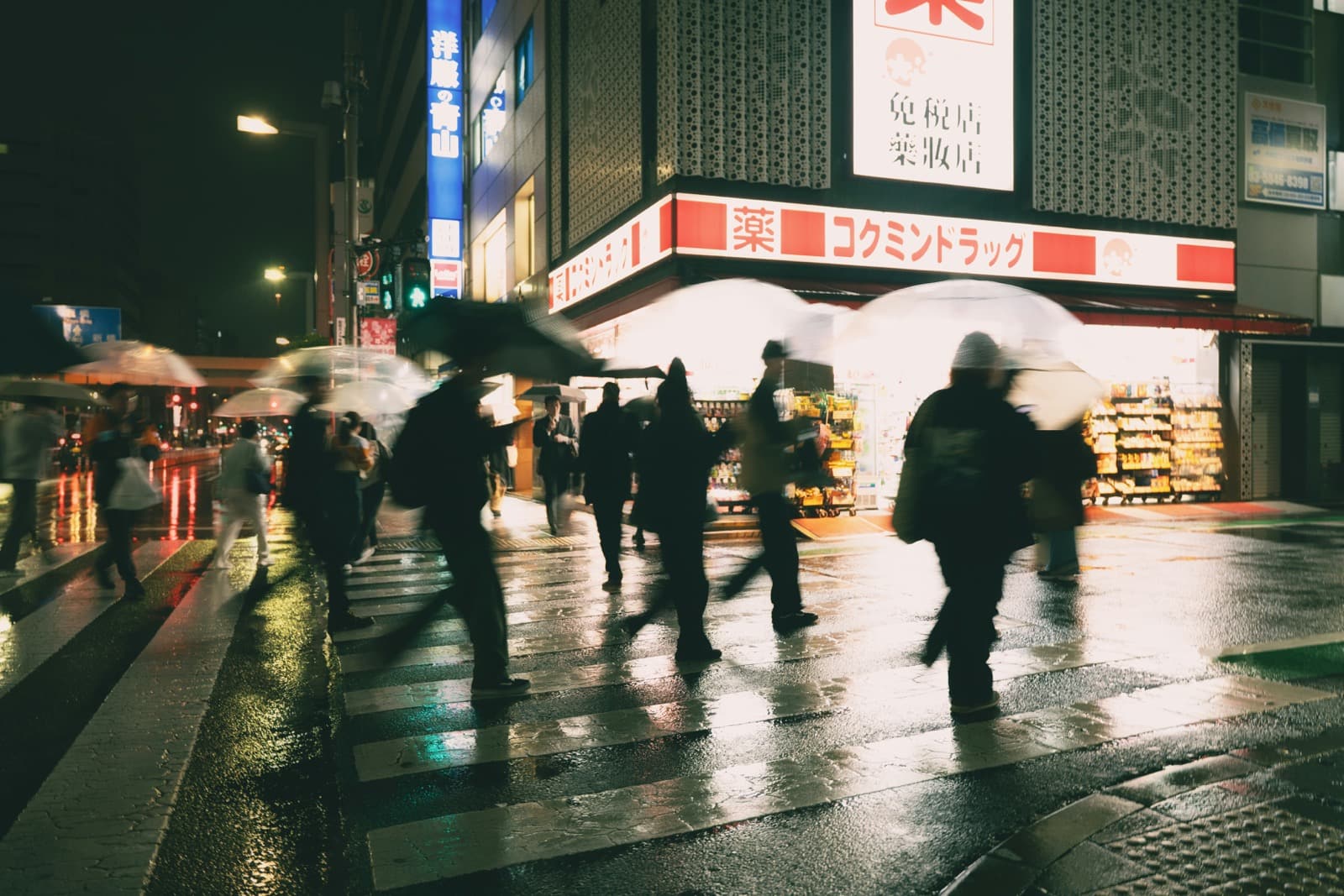
Flash changes how a recipe reads. Direct flash gives hard shadows and bright, near subjects against a falling-off background, so recipes with strong contrast exaggerate it. That is exactly why Ilford HP5 B&W, built on Hard Monotone with high contrast and strong grain, is our pick for flash at night: the look is meant to be harsh. For color, presets with a fixed white balance, such as Kodak Gold 200 (6900K) or Portra 160 (Shade), keep skin tones consistent from frame to frame, where Auto white balance can shift between a frame lit mostly by flash and one lit mostly by streetlights. Indigo Film 800 is built for neon and ambient night light; with flash at full strength it loses the cinematic glow it is designed for, so use it without flash.
Mistakes we see all the time
- Skipping the firmware update. Without GR III 2.10 or GR IIIx 1.60, the GF-2 has no dedicated mode on the camera.
- Fixing ISO at 200 in GF-2 Flash Mode. With a guide number of 3, the flash runs out of power past about a meter. Leave ISO on Auto.
- Using the GW-4 with the GF-2. The flash is optimized for an 18mm focal length and vignettes with the wide converter.
- Expecting bursts. The camera waits about two seconds between flashed frames. Time your shot instead of holding the button.
- Fighting over the hot shoe. A flash, an optical finder and a thumb grip cannot all sit there. Choose the one you need tonight.
- Full-power flash in daylight. Fill flash should be felt, not seen. Start at -1.0 EV of flash compensation.
In short
The Ricoh GR III has no built-in flash, and the right add-on for most owners is the 19 g GF-2 with firmware 2.10, used in GF-2 Flash Mode with ISO on Auto. Keep subjects within about 2 meters, or carry a P-TTL Pentax AF180FG when you need real reach or bounce. If you shoot the longer lens, the same firmware logic applies, as covered in our GR IIIx guide.
For a flash look that is meant to be gritty, get the Ilford HP5 B&W recipe, or pair flash with warm skin tones through the Kodak Gold 200 recipe ($1.99). Shooting black and white most nights? The B&W Masters bundle collects our monochrome recipes in one purchase.
Frequently asked questions
Does the Ricoh GR III have a built-in flash?
No. Ricoh's GR III and GR IIIx specification page lists only a hot shoe compatible with P-TTL auto flash, and no flash in the body. The GR II was the last GR with a built-in flash. To use flash on a GR III you mount an external unit: Ricoh's own GF-2, or a Pentax P-TTL flash such as the AF180FG or AF540FGZ II.
Does the Ricoh GF-2 flash work with the GR III?
Yes. The GF-2 was designed for the GR IV, and at launch it fired only at full power on older GR models because their flash contacts are laid out differently. Ricoh fixed that with GR III firmware 2.10 and GR IIIx firmware 1.60, both released on October 23, 2025. They add a GF-2 Flash Mode that calculates exposure from the focus distance. Update the camera before you buy or use the flash.
What is the GF-2 Flash Mode on the GR III?
It is an exposure mode added by firmware 2.10 that works only with the GF-2 attached. The camera reads the subject distance from autofocus or from your manual focus setting and calculates the exposure before the shot. It can be selected in P, Av, Tv or M and assigned to the ADJ lever or an Fn button. It does not work for video or with Snap Distance Priority, and Ricoh warns that a fixed ISO limits its accuracy.
How far does the GF-2 flash reach?
The GF-2 has a guide number of 3 at ISO 100 and 6 at ISO 400, in meters. Divide the guide number by the aperture to get the range: at f/2.8 that is about 1 meter at ISO 100 and about 2 meters at ISO 400. Each doubling of the guide number needs two stops more ISO, so ISO 1600 gives roughly 4 meters at f/2.8.
Which external flash is best for the Ricoh GR III?
For street and party snapshots, the GF-2: it is small enough to leave on the camera and has its own exposure mode since firmware 2.10. For events where you need more power or want to bounce light off a ceiling, pick the Pentax AF180FG, which Ricoh rates at guide number 18 on the GR III and which tilts for vertical bounce. The bigger AF540FGZ II is discontinued and oversized for a pocket camera.
Sources: ricoh-imaging.co.jp · ricoh-imaging.co.jp · ricoh-imaging.co.jp · ricoh-imaging.co.jp · ricoh-imaging.co.jp · photoscala.de
Get a free recipe + 15% off your first order
Our Natural Analog recipe (exact settings for the GR III, GR IIIx and GR IV) and a personal discount code, straight to your inbox.
No spam. Unsubscribe in one click.