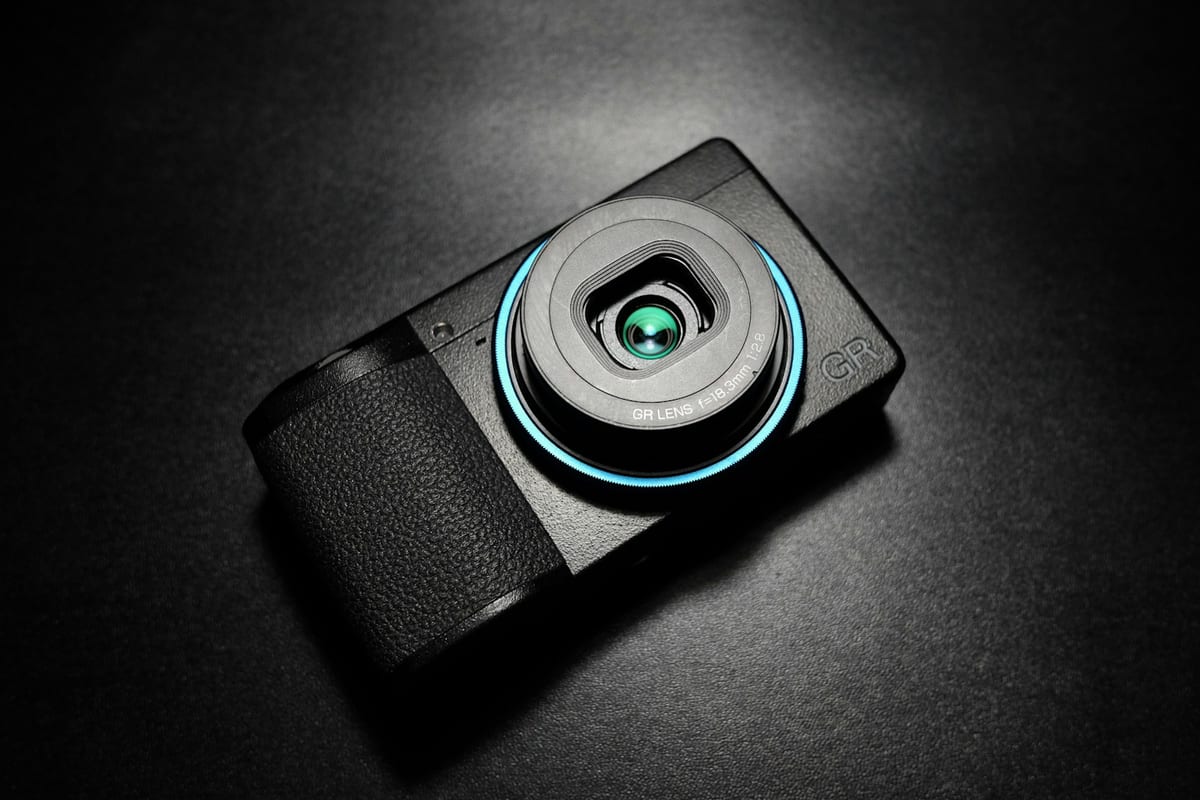
Ricoh GR III vs GR IIIx: 28mm or 40mm? (And the GR IV)
Quick answer
The Ricoh GR III and GR IIIx are the same camera with different lenses: 28mm versus 40mm equivalent, both f/2.8 on the same 24.24MP APS-C sensor. Buy the GR III (or its successor, the GR IV) for street, travel, interiors and close-ups. Buy the GR IIIx for portraits, food and calmer compositions. If you cannot decide, pick 28mm: it crops to 35mm and 50mm, and every recipe works the same on both.
Two cameras, one body, two lenses. The Ricoh GR III and the GR IIIx look identical on a shelf, share the same sensor, use the same battery and run the same menus. Yet choosing between them is the single most consequential decision a new GR buyer makes. You are not picking a feature set. You are picking a focal length you can never change.
This guide covers exactly what separates the GR III from the GR IIIx, what 28mm and 40mm feel like in practice, and where the newer GR IV fits now that it has replaced the GR III as Ricoh's 28mm model. Every spec below comes from Ricoh's official specification and product pages, checked on October 5, 2026. Good news if you worry about presets: every film recipe works identically on all three bodies.
Ricoh GR III vs GR IIIx: what's actually different
All the differences trace back to the lens. Here is the spec sheet, with the GR IV added for reference:
| Spec | Ricoh GR III | Ricoh GR IIIx | Ricoh GR IV |
|---|---|---|---|
| Lens | 18.3mm f/2.8 (28mm equiv.) | 26.1mm f/2.8 (40mm equiv.) | 18.3mm f/2.8 (28mm equiv.) |
| Construction | 6 elements, 4 groups | 7 elements, 5 groups | 7 elements, 5 groups |
| Min. focus (normal) | about 10cm | about 20cm | about 10cm |
| Macro range | about 6–12cm | about 12–24cm | from about 6cm |
| Crop modes | 35mm, 50mm | 50mm, 71mm | 35mm, 50mm |
| Sensor | 24.24MP APS-C | 24.24MP APS-C | 25.74MP back-illuminated APS-C |
| Stabilization | 3-axis | 3-axis | 5-axis, up to 6 stops |
| ISO | 100–102400 | 100–102400 | 100–204800 |
| Battery (CIPA) | DB-110, about 200 shots | DB-110, about 200 shots | DB-120, about 250 shots |
| Internal memory | about 2GB + SD | about 2GB + SD | about 53GB + microSD |
| Depth | 33.2mm | 35.2mm | 32.7mm |
| Weight (battery + card) | about 257g | about 262g | about 262g |
Two millimeters of thickness and five grams: that is the entire physical penalty for the longer lens on the GR IIIx. Both still disappear into a jacket pocket.
What's identical on the GR III and GR IIIx
This is the part spec comparisons tend to bury, and it matters more than the differences. According to Ricoh's shared GR III/GR IIIx specification page, both cameras have:
- the same 24.24MP APS-C CMOS sensor (23.5 x 15.6mm)
- 3-axis sensor-shift Shake Reduction, which Ricoh US rates at up to 4 stops on the GR III
- hybrid autofocus (phase detection plus contrast detection)
- a built-in 2-stop ND filter (except on the HDF versions, which swap it for a Highlight Diffusion Filter)
- the DB-110 battery, rated at about 200 shots, so buy spares for either camera
- Full HD video at up to 60p, with clips capped at 25 minutes
- a 3-inch touchscreen, no viewfinder and no built-in flash
Because the processing and Image Control menus are shared, every recipe written for the GR III applies unchanged to the GR IIIx. Contrast, sharpness, clarity, toning, grain, white balance shift: same parameters, same ranges, same results. Focal length changes your framing, not your color.
Living with 28mm
28mm is the focal length the GR line was built around, and it shapes how you shoot. It is wide enough that you must get close (an arm's length from your subject is normal), which is precisely why GR photographers love it. You end up inside scenes rather than observing them from across the street.
Where the GR III (and GR IV) win:
- Street photography. Wide coverage catches the gesture and the context. Combined with Snap Focus, the deep depth of field at 28mm and f/5.6 makes zone focusing close to foolproof.
- Architecture and interiors. Cafés, subway cars, narrow alleys: 28mm fits what 40mm cannot.
- Travel. One lens, one small bag, the whole scene.
- Close-ups. The 6cm macro limit lets you nearly touch a subject and still focus. The GR IIIx stops at about 12cm.
- Flexibility. Crop Mode gives you a 35mm or 50mm frame, so a GR III can become a tighter camera when needed.
The catch: 28mm is unforgiving of clutter. Backgrounds fill up fast, edges stretch faces, and you cannot stand back and isolate anything. If your photos feel busy and you cannot figure out why, focal length is often the reason.
Living with 40mm
40mm sits between 35mm reportage and 50mm classicism. It renders roughly the way you remember a scene looking: no wide-angle drama, no telephoto compression. Subjects separate from backgrounds without you doing anything clever.
Where the GR IIIx wins:
- Portraits and people. No edge distortion, flattering proportions, a comfortable shooting distance. Pair it with a soft film recipe like Rustic Portra 400 and it is a superb people camera.
- Food and objects. 40mm at 20cm is the natural tabletop framing that 28mm has to fake by moving in and distorting.
- Details and signage. Textures, hands, doorways, typography: the frame arrives pre-simplified.
- Cleaner compositions. Fewer elements in the frame means less to organize, which many beginners find easier.
- Reach. Crop to 50mm or 71mm, or add the GT-2 tele conversion lens (with the GA-2 adapter), which Ricoh rates at 75mm equivalent, or 106mm combined with the 71mm crop.
The catch: in tight spaces, 40mm hits a wall. You will back into walls trying to fit a room, wide environmental street frames are off the table, and the longer minimum focus distance rules out true close-up work.
Our pick: for a first GR, choose 28mm. It can crop to imitate the GR IIIx's tighter frames far more convincingly than the GR IIIx can widen to imitate it.
Starting settings for each focal length
The focal length changes how you set the camera up for the street, even with the same recipe loaded. These are the starting points we give readers:
| Setting | GR III / GR IV (28mm) | GR IIIx (40mm) |
|---|---|---|
| Mode | Aperture priority (Av) | Aperture priority (Av) |
| Aperture for the street | f/5.6–f/8 | f/8 |
| Snap Focus distance | 2m | 2.5–3m |
| Minimum shutter speed (Auto ISO) | 1/250s | 1/320s |
| Crop mode to try | 35mm for single subjects | 50mm for portraits |
| Recipe to start with | Kodak Gold 200 or Classic Chrome | Rustic Portra 400 |
Why the differences: depth of field gets shallower as focal length grows, so the 40mm lens needs a slightly smaller aperture and a longer snap distance to keep the same zone sharp, and a faster minimum shutter speed protects against the extra magnification of hand shake.
Where the GR IV fits in
The GR IV is now Ricoh's current 28mm GR. On paper it keeps the formula and fixes the GR III's weak points: a 25.74MP back-illuminated sensor, a redesigned 7-element lens, 5-axis stabilization rated up to 6 stops, a bigger DB-120 battery rated at about 250 shots and about 53GB of internal memory. Ricoh US also quotes a startup time of about 0.6 seconds and face and eye detection autofocus.
On October 5, 2026, Ricoh's US store listed the GR IV at $1,599.95 and the GR III at $1,049.95, both out of stock, and the GR IIIx HDF at $1,349.95. Digital Camera World's April 2026 overview of the lineup counts five GR models: GR IV, GR IV HDF, GR IV Monochrome, GR IIIx and GR IIIx HDF, and describes the GR IIIx as nearing the end of production.
So the decision in 2026 looks like this:
- Want 28mm and a new camera? The GR IV is the one to buy. Our Ricoh GR IV review covers what changed and who should upgrade.
- Want 28mm on a budget? A used GR III gives you the same focal length, the same recipes and most of the image quality.
- Want 40mm? The GR IIIx is still the only GR with a native 40mm lens. If you want one new, do not wait too long.
Both the GR IIIx and GR IV also come in HDF versions, which replace the ND filter with a Highlight Diffusion Filter that blooms bright points into a soft glow. Our HDF vs standard guide explains when that trade is worth it.
Mistakes we see all the time
- Buying 40mm because it "feels more professional." If you have never shot a fixed 40mm, test it first: shoot a weekend at a fixed 28mm and another at 40mm on whatever camera you already own (any zoom taped in place works). Then see which folder you want to keep.
- Expecting the GR IIIx to do close-ups. At about 12cm minimum in macro, it cannot match the GR III's 6cm. Food flat-lays are fine; tiny objects are not.
- Assuming crop mode is free. Cropping a GR III to 50mm throws away most of the sensor. It is a framing tool, not a replacement for a longer lens.
- Carrying old SD cards to a GR IV. The GR IV takes microSD, not SD. The 53GB internal memory covers a full day, but plan your backup cards.
- Rebuilding recipes when switching bodies. You do not need to. Copy the same Image Control values into a User mode and shoot.
In short
The GR III and GR IIIx are one camera with two lenses, so the choice is purely 28mm versus 40mm. Pick 28mm (GR III used, or GR IV new) for street, travel and interiors; pick the GR IIIx for people, food and calmer frames. If you settle on 40mm, our Ricoh GR IIIx guide covers the setup, and our guide on how to apply a recipe shows how to save your look to U1–U3 on any of these bodies. Torn between a used GR III and a new GR IV at 28mm? Our GR IV vs GR III comparison shows what the extra $550 buys. Already have a GR IIIx? Our best GR IIIx settings give you snap distances and apertures matched to the 40mm lens.
Whichever body you choose, the look comes from the settings. Start with the Kodak Gold 200 recipe ($1.99) for warm everyday color, or grab the Street Essentials bundle ($8.99) and load the same looks into either camera.
Frequently asked questions
What is the difference between the Ricoh GR III and GR IIIx?
Only the lens. The GR III has an 18.3mm f/2.8 lens (28mm equivalent, 6 elements in 4 groups) and the GR IIIx has a 26.1mm f/2.8 lens (40mm equivalent, 7 elements in 5 groups). Ricoh's spec sheet lists the same 24.24MP APS-C sensor, 3-axis stabilization, 2-stop ND filter, ISO 100 to 102400, DB-110 battery and Full HD video for both. The GR IIIx is 2mm thicker and focuses no closer than about 12cm in macro, against 6cm on the GR III.
Is the GR IIIx better than the GR III for street photography?
For most street photographers, no. The 28mm GR III shows more context, makes zone focusing easier thanks to deeper depth of field, and can crop to 35mm or 50mm when you need a tighter frame. The GR IIIx suits a quieter street style: single subjects, details, signage and people at a comfortable distance. If your best frames are already tight portraits of strangers, 40mm will feel natural.
Should I buy the Ricoh GR IV instead of the GR III?
If you want 28mm and can find one, yes. The GR IV keeps the 28mm f/2.8 formula but adds a 25.74MP back-illuminated sensor, 5-axis stabilization rated up to 6 stops, a DB-120 battery rated at about 250 shots and 53GB of internal memory. Ricoh US listed it at $1,599.95 on October 5, 2026. The GR III stays the cheaper choice on the used market.
Is there a 40mm version of the Ricoh GR IV?
Not as of October 2026. Ricoh's GR IV specification page lists one 18.3mm (28mm equivalent) lens with 35mm and 50mm crop modes, in standard and HDF versions. The GR IV line also includes a Monochrome model. If you want a native 40mm GR, the GR IIIx and GR IIIx HDF are still the only options.
Do Ricoh GR III recipes work on the GR IIIx and GR IV?
Yes. The GR III and GR IIIx share the same Image Control menu, so a recipe gives identical results on both bodies. The GR IV keeps the same Image Control profiles and adjustable parameters, so the same recipe loads into a User mode unchanged. The GR IV's new sensor can shift color a little, so check white balance on your first shots and nudge it if needed.
Sources: ricoh-imaging.co.jp · ricoh-imaging.co.jp · us.ricoh-imaging.com · us.ricoh-imaging.com · us.ricoh-imaging.com · digitalcameraworld.com
Get a free recipe + 15% off your first order
Our Natural Analog recipe (exact settings for the GR III, GR IIIx and GR IV) and a personal discount code, straight to your inbox.
No spam. Unsubscribe in one click.