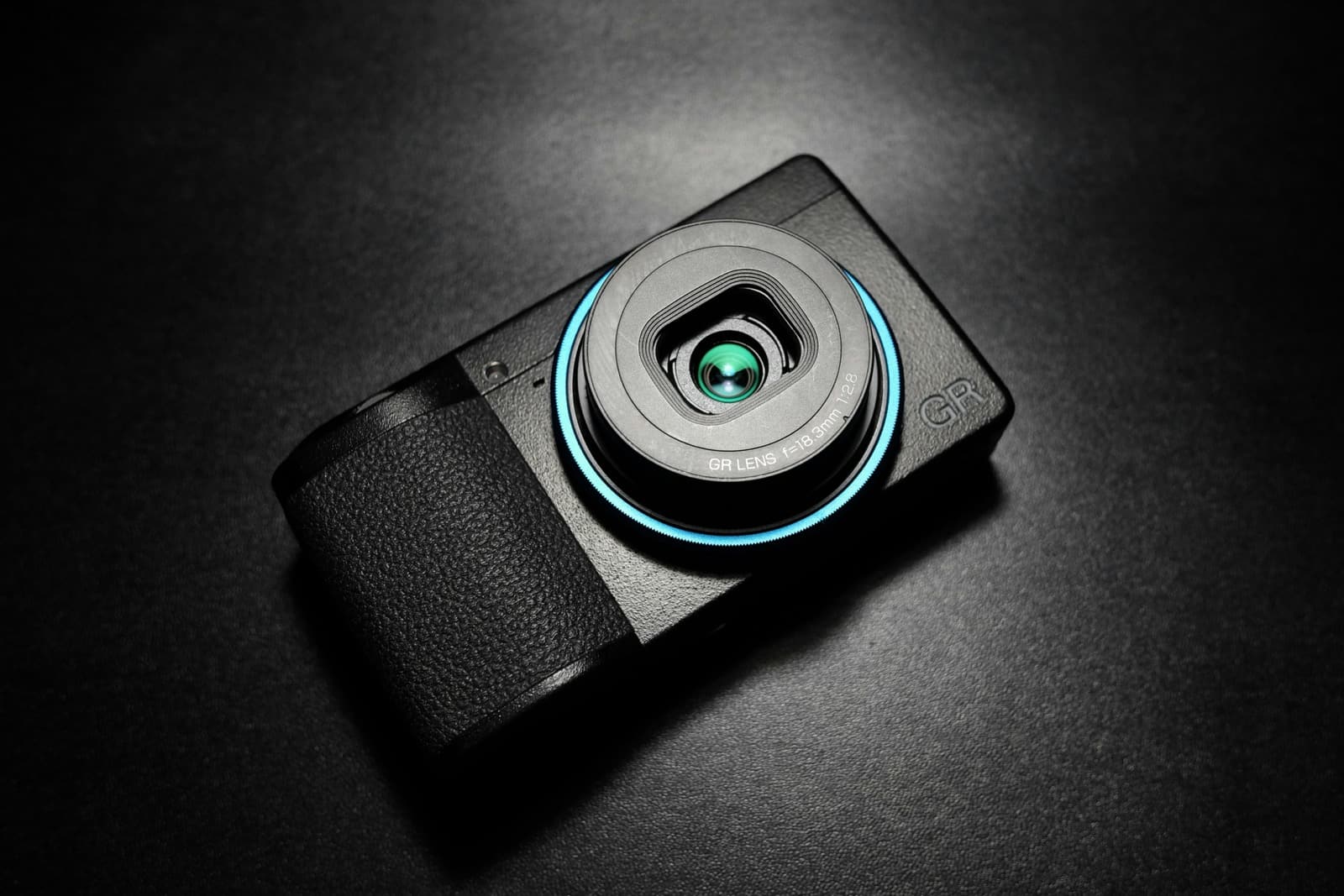
Ricoh GR IV vs GR III: Which One Should You Buy?
Quick answer
Buy the Ricoh GR IV if you shoot handheld at night, travel all day on one battery or care about sharp frame edges: it adds 5-axis stabilization rated up to 6 stops, about 250 shots per charge and 53GB of internal memory. Buy the GR III if you shoot mostly in daylight and want the same 28mm look for $550 less ($1,049.95 vs $1,599.95 list). Film recipes work the same on both.
The Ricoh GR IV and GR III look like the same camera. Both have a 28mm-equivalent f/2.8 lens, an APS-C sensor, no viewfinder and a body that fits in a jeans pocket. The differences are inside, and they cost $550 at today's list prices. This guide helps you decide whether that money buys anything you will use.
A note on method: we have not shot a GR IV ourselves. Every spec and price below comes from Ricoh's official specification pages, Ricoh Imaging Americas' product pages and DPReview's in-depth GR IV review, all read on October 13, 2026. The recipe advice comes from building film looks on the GR III. If you want the full picture of the newer camera on its own, read our Ricoh GR IV review; this page is about choosing between the two.
Ricoh GR IV vs GR III: the specs side by side
| Spec | Ricoh GR IV | Ricoh GR III |
|---|---|---|
| Sensor | 25.74MP back-illuminated APS-C, 23.3 x 15.5mm | 24.24MP APS-C, 23.5 x 15.6mm |
| Lens | 18.3mm f/2.8 (28mm equiv.), 7 elements in 5 groups, 3 aspherical | 18.3mm f/2.8 (28mm equiv.), 6 elements in 4 groups, 2 aspherical |
| Macro range | About 6 to 15cm | About 6 to 12cm |
| Stabilization | 5-axis, up to 6 steps (center) | 3-axis, 4 steps |
| ISO | 100 to 204800 | 100 to 102400 |
| Built-in ND filter | 2EV | 2EV |
| Battery | DB-120, about 250 shots | DB-110, about 200 shots |
| Storage | About 53GB internal + microSD | About 2GB internal + SD |
| Image Control | 14 modes + 3 custom slots | 12 modes + 2 custom slots |
| Video | Full HD up to 60p | Full HD up to 60p |
| Size and weight | 109.4 x 61.1 x 32.7mm, 262g | 109.4 x 61.9 x 33.2mm, 257g |
| US list price (Oct 13, 2026) | $1,599.95 | $1,049.95 |
Both product pages showed "out of stock" when we checked, so availability matters as much as list price right now. Our GR III price guide tracks new, refurbished and used prices for every current GR.
Our pick: for most first-time buyers who can afford it, the GR IV. For daylight street and travel shooters on a budget, the GR III is still the better value.
The three differences you will actually feel
Spec tables make the cameras look far apart. In use, three changes matter. The rest is small print.
1. Stabilization after dark. DPReview reports the GR IV's 5-axis system at up to six steps at the center of the frame (four at the edges), against a 4EV rating for the GR III's 3-axis system. Two extra steps mean you can handhold a shutter speed four times slower for the same sharpness, or stay two ISO stops lower. For a night street shooter, that is the difference between ISO 6400 and ISO 1600 on the same scene. Moving subjects still blur, because stabilization only cancels your hand shake.
2. Battery and storage on long days. Ricoh rates the DB-120 at about 250 shots and the GR III's DB-110 at about 200. Neither number is generous; you still need a spare. The bigger change is storage: about 53GB built in against 2GB. On the GR IV you can leave the house without a card. On the GR III the internal memory is an emergency buffer and little more.
3. Edge sharpness. The GR IV has a new 7-element lens, and DPReview found it delivers "more consistent performance across the frame than its predecessor." In other words, the edges hold up better than on the GR III. If you shoot architecture, signage or tight compositions where something important sits near the edge, you will see it. If your subject is usually in the middle third, you mostly won't.
Where the two cameras are the same
This list is longer than people expect, and it is why the GR III remains a good buy:
- The same 28mm-equivalent field of view and f/2.8 maximum aperture.
- The same crop modes: 35mm and 50mm equivalents.
- A 2EV built-in ND filter on the standard model of both.
- The same 3.0-inch screen with about 1,037,000 dots, fixed, with no viewfinder.
- Full HD video up to 60p and no 4K on either camera.
- Hybrid autofocus (phase detection plus contrast) on both.
On autofocus, DPReview found the GR IV's single AF "generally quick and accurate," but its continuous AF "far more likely to hunt" and called the autofocus dated overall. Neither camera is a tracking camera. For street work, most GR shooters zone focus anyway, and the GR IV adds a Snap Distance Priority exposure mode that builds that habit into the camera.
Controls: the GR IV goes back to the GR II layout
This is the difference spec sheets hide. According to DPReview, the GR IV replaces the GR III's rear dial with a multi-directional controller, brings back the +/- rocker switch for exposure compensation, and turns the ADJ lever into a clickable command dial.
What that means for you depends on where you are coming from. If you learned on a GR II, the GR IV will feel like home. If your hands know the GR III, expect a week of reaching for controls that moved. Neither layout is wrong; just don't buy the GR IV expecting identical muscle memory.
The card format changed too: the GR IV takes microSD (UHS-I), and DPReview calls the microSD slot "mildly annoying." Your GR III's SD cards and spare batteries won't carry over.
Film recipes on the GR IV vs the GR III
For us, this is where the comparison gets interesting, and where the GR III holds up best.
| Recipe feature | GR IV | GR III |
|---|---|---|
| Negative Film, Positive Film, Retro, Bleach Bypass, Cross Processing, HDR Tone | Yes | Yes |
| Standard, Vivid and the Monotone family | Yes | Yes |
| Cinema (Yellow) and Cinema (Green) | Yes | No |
| Custom slots | 3 | 2 |
| White balance fine-tune | ±14 steps, A-B and G-M | Yes |
Every Image Control on the GR III's spec page appears on the GR IV's, so every recipe we sell runs on both cameras. Ricoh's GR IV page lists the same adjustable parameters our recipes use: saturation, hue, high/low key, contrast, highlight and shadow contrast, sharpness, shading, clarity, toning and grain effect.
Three things change in practice:
- The third custom slot. On the GR III you pick two looks to keep loaded. On the GR IV you can keep a daylight color recipe, a night recipe and a black-and-white recipe at once. For a recipe shooter, this is the most useful upgrade that costs nothing to use.
- Cinema modes. Cinema (Yellow) and Cinema (Green) are new bases with no GR III equivalent. On a GR III, the closest route to a movie-film look is a tungsten white balance on Positive Film or Retro, which is how our night recipes work.
- JPEG color. DPReview found GR IV JPEG colors "a bit more pleasing than the GR III's," while also listing JPEG softness as a con. A new sensor also means the same settings can render white balance slightly differently, so check your first frames against your GR III shots and adjust white balance before touching saturation.
Our Ricoh GR IV recipes guide shows which three looks to load into Custom 1 to 3 and how to save them with the GR WORLD app.
Our pick: if recipes are the main reason you shoot a GR, the GR III gives you 95% of the experience. The GR IV's third slot is a convenience, not a new capability.
Which one should you buy?
Buy the GR IV if:
- You shoot handheld after sunset at least once a week.
- You travel and want one battery, no card and fewer worries.
- Edge sharpness matters for your subjects.
- You learned on a GR II and prefer the rocker-and-buttons layout.
Buy the GR III if:
- You shoot mostly in daylight, where the stabilization gap barely shows.
- You already own SD cards and DB-110 batteries.
- You would rather spend the $550 difference on travel, prints or a spare battery and a recipe bundle.
- You found a well-kept used or refurbished copy. Our checklist for buying a used GR III covers the dust test and what to ask the seller.
Already own a GR III? Keep it unless one of the three differences above is costing you photos today. And if you are still choosing between focal lengths rather than generations, our GR III vs GR IIIx comparison covers 28mm against 40mm; the GR IV only comes in 28mm.
Mistakes we see all the time
- Paying for megapixels. 25.74MP against 24.24MP is a 6% increase. You will not see it in a print or on a phone.
- Expecting tracking autofocus. DPReview's main complaint about the GR IV is continuous AF. If you shoot kids or sports, neither GR is the right tool.
- Buying a GR III above list price. When the GR III is out of stock, marketplace sellers often ask more than Ricoh's $1,049.95. At that point the GR IV gap shrinks and the newer camera becomes the better deal.
- Forgetting the accessories. Batteries (DB-120 vs DB-110) and cards (microSD vs SD) don't cross over. Budget for a spare battery on either camera.
- Assuming recipes need rebuilding. They don't. Enter the settings, then fine-tune white balance on the GR IV.
In short
The GR IV is the better camera, with stronger stabilization, a longer-lasting battery, 53GB of storage and a sharper lens at the edges. The GR III is the better value, delivering the same 28mm look, the same Image Control bases and the same recipes for $550 less. Night and travel shooters should buy the GR IV; daylight street shooters should buy the GR III, and our Ricoh GR III review explains why it still holds up years after launch.
Whichever you choose, your first recipe works on both. Start with the Kodak Gold 200 recipe ($1.99) for warm daylight color and Indigo Film 800 for night streets, or get both looks and more in the Street Essentials bundle ($8.99).
Frequently asked questions
Is the Ricoh GR IV better than the GR III?
Yes, on almost every measurable point. Ricoh's spec pages give the GR IV a 25.74MP back-illuminated sensor (24.24MP on the GR III), 5-axis stabilization instead of 3-axis, ISO up to 204800 instead of 102400, a 250-shot battery instead of 200, and 53GB of internal memory instead of 2GB. DPReview also found its lens more consistent across the frame. The GR III still wins on price and on SD card compatibility.
How much more does the GR IV cost than the GR III?
$550 at Ricoh's US list prices, read on October 13, 2026: the GR IV lists at $1,599.95 and the GR III at $1,049.95. Both product pages showed the cameras as out of stock that day. At launch the gap was $600, since DPReview gives the GR III's launch price as $899 and the GR IV's as $1,499.
Should I upgrade from a GR III to a GR IV?
Only if one of three things holds you back today: blurry handheld shots after dark, running out of battery, or soft frame edges. DPReview gives the GR IV's stabilization a rating of up to six steps, against 4EV for the GR III. If your complaints are about color or mood, a new recipe will change your photos more than a new body.
Do GR III recipes work on the GR IV?
Yes. All twelve Image Control modes on the GR III spec page, including Negative Film, Positive Film, Retro, Bleach Bypass and Hard Monotone, are also listed for the GR IV, which adds Cinema (Yellow), Cinema (Green) and a third custom slot. Enter the recipe as written, then check white balance on your first shots, since the GR IV uses a different sensor.
Is the GR IV the same size as the GR III?
Nearly. Ricoh lists the GR IV at 109.4 x 61.1 x 32.7mm and 262g with battery and card, and the GR III at 109.4 x 61.9 x 33.2mm and 257g. The GR IV is slightly thinner and 5g heavier, so cases and pockets that fit one fit the other. The batteries are different, though: DB-120 on the GR IV, DB-110 on the GR III.
Sources: ricoh-imaging.co.jp · ricoh-imaging.co.jp · us.ricoh-imaging.com · us.ricoh-imaging.com · dpreview.com
Get a free recipe + 15% off your first order
Our Natural Analog recipe (exact settings for the GR III, GR IIIx and GR IV) and a personal discount code, straight to your inbox.
No spam. Unsubscribe in one click.