Ricoh GR III Accessories: What's Actually Worth Buying (And What Isn't)
The Ricoh GR III is the rare camera where every accessory is a trade-off against the entire point of the thing. You bought a camera that disappears into a jacket pocket. Bolt enough onto it and you've built a worse, more expensive X100.
So this isn't a list of everything you can buy. It's a list of what survives contact with real shooting — sorted into things that earn their place, things that depend on how you shoot, and things the Ricoh GR III already handles without your money.
The Five That Earn Their Place
1. Two spare DB-110 batteries
Not one. Two.
The GR III is CIPA-rated for around 200 shots per charge, and CIPA numbers are generous relative to how people actually shoot — a lot of half-pressing, chimping and menu-diving. A full day of street shooting will empty a battery before lunch, and the DB-110 is small enough that three of them weigh less than a phone.
Ricoh's own cells are fine but overpriced. Third-party DB-110s from established brands are a legitimate saving here, because there's nothing clever happening in this battery — it's a 1350mAh cell with a standard contact layout.
Pro tip: the Ricoh GR III charges over USB-C in-camera, which means a small power bank doubles as a charger. If you're travelling and already carrying one, you can arguably get away with one spare battery and top up over lunch. The catch is that in-camera charging occupies the camera — you can't shoot while it charges. That's exactly why the second spare exists.
2. The BJ-11 external charger (or any DB-110 dock)
Related to the above and frequently skipped, because the GR III ships without an external charger and USB-C charging feels like enough. It isn't, the moment you own more than one battery — charging three cells sequentially through the camera body takes most of an evening and leaves the camera tied up.
A cheap dual dock that charges two DB-110s at once solves this permanently. This is the least glamorous purchase on this list and probably the one that changes your shooting most.
3. A 49mm clear filter plus the GA-1 lens adapter
This is the accessory that addresses the GR III's most notorious weakness: dust on the sensor.
The lens assembly retracts into the body every time the camera powers down, and that movement pumps air — along with whatever's in it — through the barrel. Enough cycles in enough dusty environments and you get visible specks in your skies at f/8 and smaller. It is the single most common Ricoh GR III complaint, and it is not a defect so much as a consequence of the design.
The GA-1 adapter screws onto the lens ring and provides a 49mm filter thread. Fit a plain clear or UV filter and the front of the lens assembly is sealed against the outside world. Sensor dust doesn't stop entirely — it can never entirely stop — but the rate drops sharply.
The trade-off is real and worth stating plainly: the GA-1 is a rigid tube that adds roughly 3cm to the front of the camera and ends its pocketability. Many owners fit it for beach, desert and festival trips and take it off in the city. That's the correct way to use it.
4. A wrist strap, not a neck strap
The GR III is a one-handed camera. Everything about it — the grip, the thumb-reachable ADJ lever, the snap focus workflow — assumes the camera lives in your right hand and comes up to your eye in one motion. A neck strap makes it dangle at chest height and swing, which is exactly what you don't want when the whole appeal is being unobtrusive.
A short wrist strap keeps the camera in your palm, ready, and stops a dropped grip from becoming a dropped camera. Any decent one works; the anchor-style quick-release systems are worth the small premium because you'll want to remove it for pocket carry.
5. A screen protector
A tempered glass protector costs almost nothing and the GR III's touchscreen is both the focus-point selector and the thing that rides against your keys. Buy two, fit one, forget about it.
The Three That Depend on How You Shoot
The GW-4 wide conversion lens (21mm equivalent)
The GW-4 turns the GR III's 28mm into a 21mm, and it requires the GA-1 adapter to mount. Optically it's genuinely good — this is a proper Ricoh conversion lens, not a screw-on toy — and 21mm is a real creative shift, not a marginal one. It opens up cramped interiors, tight urban architecture and the exaggerated-foreground style of street work that 28mm can't quite reach.
It also makes the camera look like a small telescope and weighs more than you'd guess. Buy it if you know you want 21mm. Don't buy it hoping to discover that you do.
(GR IIIx owners: your equivalent is the GT-2 tele conversion, which takes 40mm to 75mm and needs the GA-2 adapter. If you're still deciding between bodies, our GR III vs GR IIIx comparison covers the focal length question properly.)
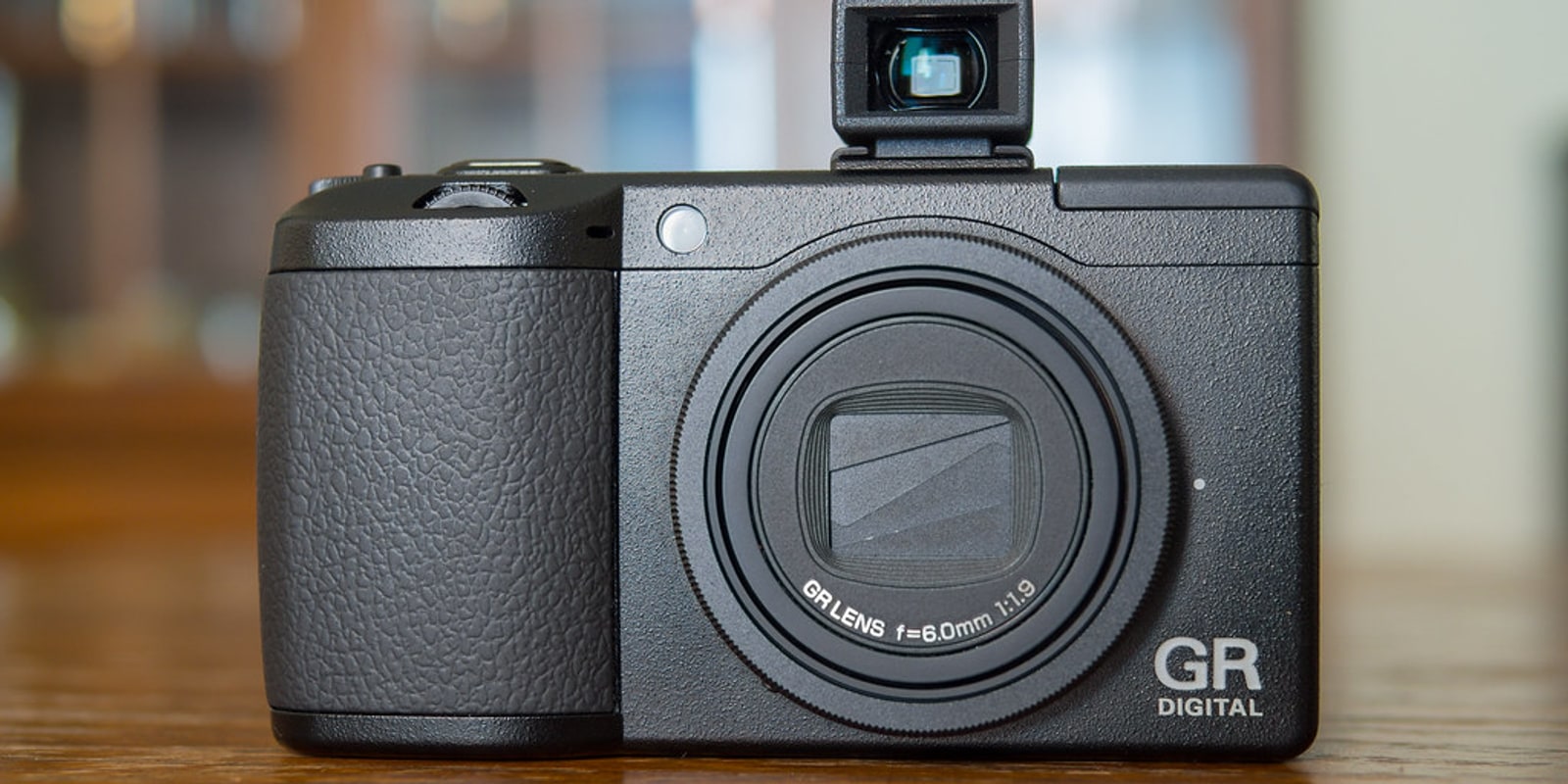
An external optical viewfinder (GV-1, GV-2, GV-3)
Ricoh's hot-shoe optical finders are discontinued and now trade secondhand at prices that would embarrass a new lens. The GV-1 offers 21mm and 28mm framelines, the GV-2 is a more compact 28mm-only unit, and the GV-3 covers 40mm for the GR IIIx.
They are not a gimmick. Composing through glass instead of a screen changes how you shoot — you hold the camera differently, you're steadier, and in bright sun you can actually see what you're framing when the LCD has given up. If you shoot zone-focused street work at f/8, you don't need autofocus confirmation, so the finder loses nothing.
But they show framing only — no exposure information, no focus point, no parallax correction up close. This is a stylistic purchase for a specific kind of photographer, and if you're not sure you're that photographer, you aren't yet.
A thumb grip
Hot-shoe thumb rests improve one-handed stability meaningfully, especially if you have larger hands, and they're the reason a lot of people stop dropping the camera. They also permanently occupy the hot shoe, which means no optical finder and no flash. Pick one or the other.
What You Can Skip
An external ND filter. The Ricoh GR III has a built-in 2-stop ND filter — set it to Auto or On in the shooting menu. It's there for shooting wide open in daylight and for long exposure work. Screwing an ND onto a GA-1 is only worth it if you need more than two stops.
A UHS-II SD card. The GR III's card slot is UHS-I. A fast V30 UHS-I card empties the buffer as quickly as the camera can manage; a UHS-II card costs more and runs at exactly the same speed in this body. Spend the difference on a second card instead — and remember the internal memory is only about 2GB, which is a backup, not a plan.
A cage, rig, or anything with a cold shoe on it. If you need that, you need a different camera.
A blower for the sensor. A rocket blower is useful for the exterior and the lens barrel, but the GR III's sensor sits behind a sealed lens assembly you cannot safely reach. Blowing air into a retracted lens can push dust further in. Prevention via the GA-1, and professional cleaning when it gets bad, are the only two real options.
The Accessory Nobody Sells You
The thing that improves GR III output most isn't in a box. It's having the camera already configured before the moment arrives — a colour recipe, a monochrome recipe and a night recipe saved into U1, U2 and U3, snap focus set to 2m, and a habit of not looking at the screen.
Gear can't buy you that, but a good starting point helps. Our preset collection gives you the full recipe — Image Control base, every parameter, and white balance — for looks from Kodak Gold 200 to Indigo Film 800, and applying one takes about two minutes per User slot. Moving up to the newer body? Our Ricoh GR IV accessories guide lists which of these still fit and which you need to replace. Thinking about putting a flash in that hot shoe? Our Ricoh GR III flash guide compares the GF-2 with Pentax P-TTL units and gives the settings to use.
Cover photo: "Ricoh GR Digital 3 & GV-2 optional viewfinder" by Ivan Radic, licensed under CC BY 2.0.
Get a free recipe + 15% off your first order
Our Natural Analog recipe (exact settings for the GR III, GR IIIx and GR IV) and a personal discount code, straight to your inbox.
No spam. Unsubscribe in one click.