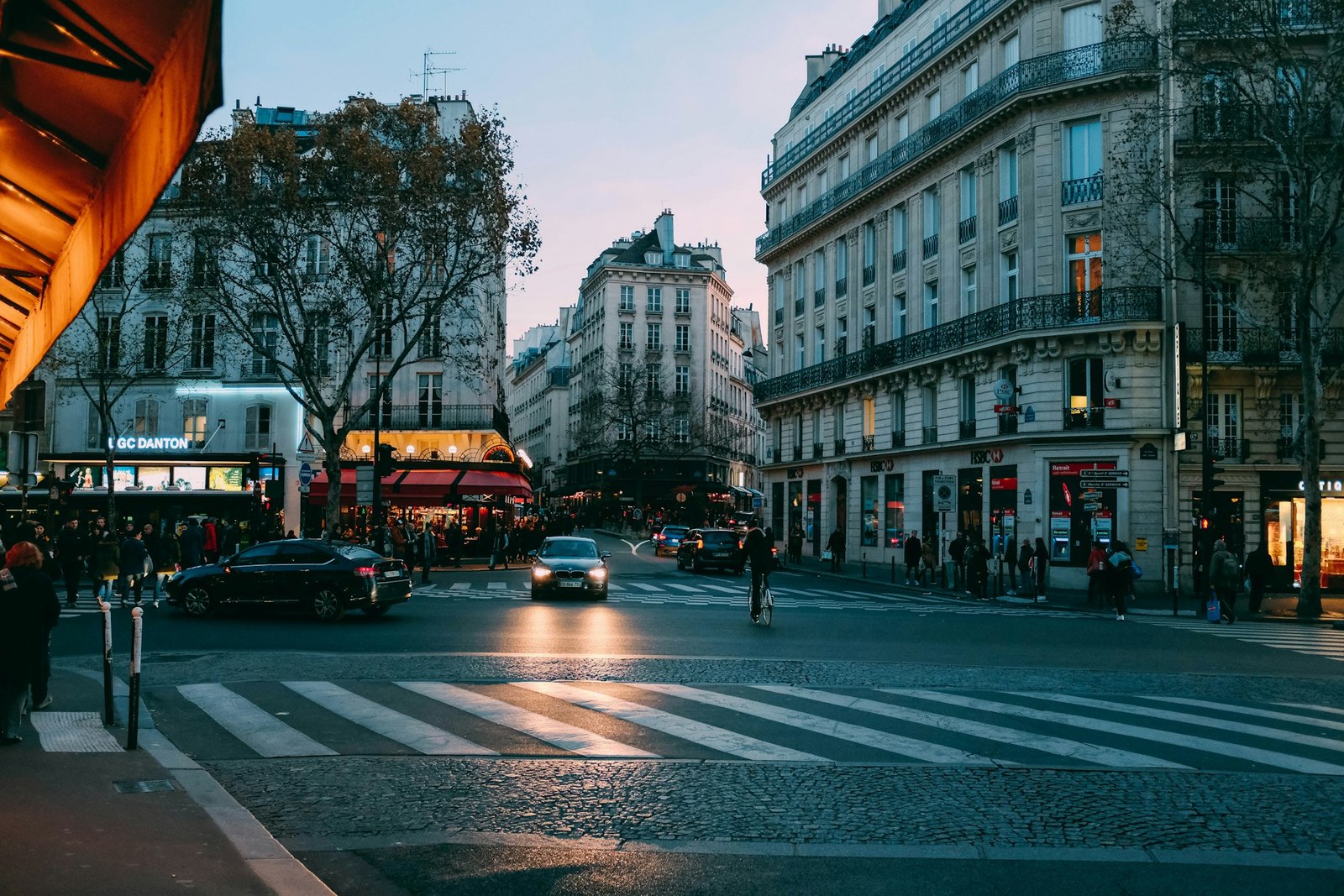
Paris Street Photography with the Ricoh GR III: Settings, Arrondissements and Recipes
Everyone arrives in Paris expecting the photographs to make themselves. The city is beautiful, the light is famous, the buildings are already composed. Then you get home and the folder is four hundred frames of flat grey stone under flat grey sky, and you can't work out what went wrong.
What went wrong is that Paris is a monochrome city pretending to be a colour one. Haussmann's limestone is cream. The rooftops are grey zinc. The sky is overcast for most of the year. Left to its own devices, the Ricoh GR III will meter all of that correctly and give you a technically perfect photograph of nothing.
Paris rewards a specific setup, and it isn't the one that works in Tokyo. Here it is.
The Core Paris Setup
Load this into U1 — see the U1/U2/U3 user modes guide if you haven't configured them yet.
- Mode: Av
- Aperture: f/5.6 overcast, f/8 in sun
- Focus: Snap, set to 3.5m
- Auto ISO: 100–3200, minimum shutter 1/200s
- Metering: Multi-segment
- Exposure compensation: +0.3 EV
- Image Control: your recipe of the day
Three of those numbers are deliberately different from the usual street defaults.
3.5m, not 2.5m. Paris pavements are wider than Tokyo's and the boulevards are enormous. Your subject sits further away — someone crossing rue de Rivoli, a café terrace across the street, a figure under the arcades at Palais-Royal. At f/5.6 with snap at 3.5m you get roughly 2m to 9m sharp, which covers almost every frame you'll actually take. Drop to 2m in the Marais' narrow lanes. The snap focus and zone focusing guide has the full depth-of-field tables.
Positive exposure compensation, not negative. This is the reversal that catches people out. In a neon city you dial in −0.3 EV to protect highlights. In Paris you're shooting pale limestone under a bright overcast sky, and the GR III's meter reads all that brightness as "too bright" and stops down — so your buildings come back muddy and your whites come back grey. +0.3 EV is the Paris default, and +0.7 EV is correct on a genuinely white-sky day. Check the histogram once in the first hour and commit.
Multi-segment, not Highlight-Weighted. There's no runaway signage to protect against here. Highlight-weighted metering will just chase the brightest patch of sky and underexpose everything beneath it.
The Light Problem Nobody Warns You About
Paris is overcast roughly two days in three. That soft, shadowless light is genuinely lovely for faces and terrible for architecture — it flattens the relief that makes Haussmann facades interesting in the first place.
The fix is not to wait for sun. It's to stop shooting facades and start shooting into windows, through arcades, and along wet ground. Overcast light is directional the moment it has to squeeze through something. The shadow and light approach applies here more than anywhere.
For rendering, grey days need a recipe with some backbone. Classic Chrome is the honest documentary choice — muted, cool, unhurried, and it treats limestone as stone rather than as cream. When the sky actually opens up, Kodak Gold 200 puts the warmth back into the stone without going full postcard.
Arrondissement by Arrondissement
The Marais (3rd and 4th)
Narrow medieval streets, hard shadow edges, the best light in the city between about 4pm and sunset because the sun rakes down the length of the lanes rather than falling on them from above.
Snap to 2m, f/4, and shoot the shadow edges. This is the one part of Paris that behaves like a dense Asian city — tight, layered, no room to step back. The GR III's pocketability is the whole point here.
Dramatic Monochrome is the right answer more often than not. The Marais is about geometry and contrast, not colour.
Montmartre and the 18th
Steep, touristy at the top and completely ordinary two streets down, which is where the photographs are. Shoot the staircases, not the Sacré-Cœur. Early morning before the crowds arrive is the only time the Butte is workable.
f/8, snap 3.5m, ISO 200. Warm, slightly nostalgic rendering suits it — Rustic Portra 400 handles skin tones on the terraces and keeps the rendered stone from going chalky.
Canal Saint-Martin and the 10th/11th
Younger, scruffier, the Paris people actually live in. Iron footbridges, water reflections, graffiti, people sitting on the quai with a bottle. Best in late afternoon.
This is reflection photography country — shoot the canal surface at f/8 and meter for the reflection, not the sky. Americana Color suits the slightly faded, sun-bleached feel of the quais in summer.
The grand boulevards and the 1st/8th
Wide, formal, hard to photograph without producing a postcard. The move is to shoot low and long — down the length of a boulevard at f/8 with a foreground element, so the scale reads. Or go in the rain.
Blue hour, everywhere
Paris at blue hour is the reason to carry the camera at all. Sodium and warm-white street lighting against a deep blue sky, wet cobbles, café windows glowing. f/2.8, ISO up to 6400, minimum shutter 1/125s, and lock white balance around 4200K rather than letting Auto chase the streetlamps. The white balance guide covers why Auto struggles with sodium.
Indigo Film 800 is built for exactly this — it keeps the sky properly blue instead of letting it drift grey-magenta as the ambient light drops.
Three Things That Will Save Your Trip
Pro tip: the Eiffel Tower light show is copyrighted. The tower itself is public domain — it was completed in 1889 and the structure's copyright expired long ago. But the illuminations installed in 1985, and the sparkling display, are a separately protected artistic work. Daytime photos of the tower are unrestricted. Night photos, if you intend to sell or license them commercially, legally require permission from the operating company. In practice nobody comes after your Instagram, but if you're shooting stock or selling prints, shoot it in daylight or shoot it as a silhouette at dusk before the lights come on.
Know French image rights. Droit à l'image is genuinely stricter than the US or UK. Taking the photograph in a public place is legal. Publishing a photograph in which a person is individually identifiable and recognisable, without their consent, is where the exposure sits — crowd scenes and people who are incidental to a wider scene are fine, a tight frame of one stranger's face is not. Shoot freely; be thoughtful about what you publish.
Rain is an upgrade, not a setback. Paris rain is usually light and brief, the cobbles go reflective, the café windows steam up, and the tourists vanish. The GR III is not weather-sealed, so keep it under a jacket between frames and carry a microfibre cloth — but do go out. The rainy day settings guide covers the technique.
Indoors: Cafés, Passages and Museums
The covered passages of the 2nd — Galerie Vivienne, Passage des Panoramas — are the single most underrated photographic location in Paris. Glass roofs, mosaic floors, and light that falls like a studio softbox. f/2.8, ISO 1600, snap off, AF centre point.
Café interiors are dim and warm; the café and coffee shop guide has the settings. For the Louvre, Orsay and the rest, check the museum and gallery guide — most permit photography without flash, and the GR III's silent leaf shutter makes it the ideal museum camera. And the Métro, if you're shooting it, has its own settings guide.
The Short Version
- Snap focus 3.5m, f/5.6, 1/200s minimum for boulevards; 2m and f/4 in the Marais
- +0.3 EV, multi-segment metering — Paris limestone fools the meter the opposite way from a neon city
- Lock white balance to ~4200K after dark; Auto WB can't decide about sodium lighting
- Shoot through things on overcast days — arcades, windows, passages — rather than at flat facades
- Daylight for the Eiffel Tower if the photos are going anywhere commercial
- Two batteries is enough; Paris days are shorter on the shutter than Tokyo's, though the battery guide still applies in winter cold
The Ricoh GR III suits Paris for the same reason it suits any city with café terraces: nobody takes a small black compact seriously, and not being taken seriously is the entire job.
If you'd rather have the grey-day, golden-stone and blue-hour looks loaded into U1, U2 and U3 before you land, our full preset collection has them ready to copy straight into the camera.