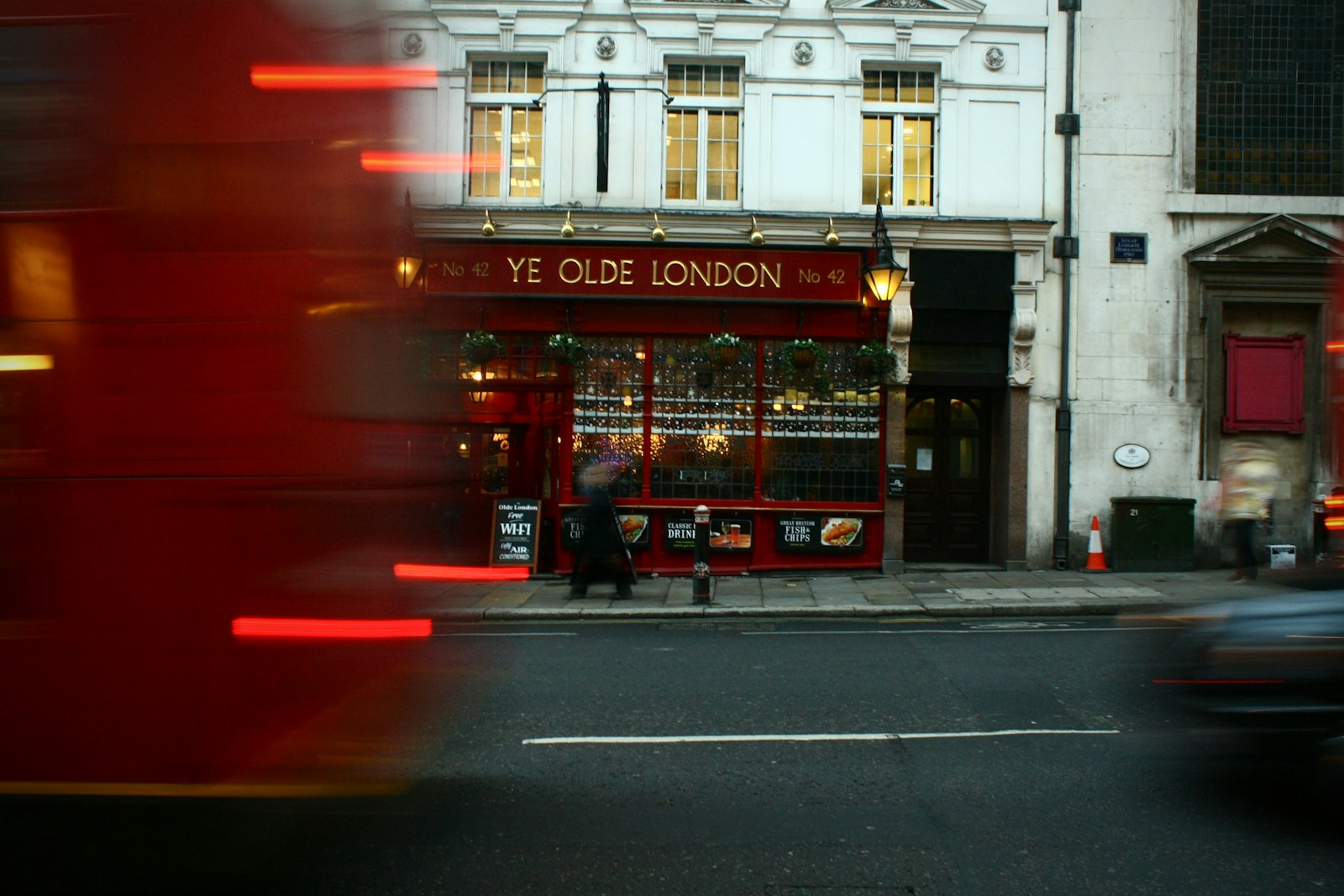
London Street Photography with the Ricoh GR III: Settings, Neighbourhoods and Recipes
Everything written about street photography assumes light exists.
London is the city that tests that assumption. For most of the year the sky is a single sheet of grey with no direction in it — no shadow side, no highlight side, no modelling on anyone's face. The buildings are Portland stone and dark brick and glass, all of which go to the same dead middle grey under a flat sky. Your Ricoh GR III will meter it perfectly and give you a technically correct photograph of nothing.
New York is a contrast problem. Paris is a tone problem. London is a contrast deficit problem, and almost every setting below is about manufacturing separation the sky refuses to provide.
The Core London Setup
Load this into U1 — the U1/U2/U3 user modes guide covers how if you haven't set them up.
- Mode: Av
- Aperture: f/4 (f/5.6 only if the sun genuinely appears)
- Focus: Snap, set to 2m
- Auto ISO: 100–6400, minimum shutter 1/125s
- Metering: Multi-segment
- Exposure compensation: +0.3 EV, or +0.7 EV with sky in frame
- Image Control: your recipe of the day, contrast pushed +1
Four of those are the London-specific calls.
f/4, not f/8. This is the one most visitors get wrong. They arrive with a "street photography" setup borrowed from a sunnier city and spend the day at ISO 3200 in the middle of the afternoon. London's ambient light on an overcast December day at street level is frequently EV 9–10 — roughly indoor window light. Open up. You still get plenty of depth of field at f/4 on an 18.3mm lens.
Positive exposure compensation, not negative. The exact inverse of the New York rule. An overcast sky is two to three stops brighter than the street beneath it, so the moment sky enters your frame, multi-segment metering drags everything else down and you get grey stone that looks like wet cardboard. +0.3 EV as a baseline, +0.7 EV whenever you're shooting up a street with sky at the top. Yes, you'll clip the sky. The sky is a featureless white rectangle — there is nothing in it to protect. The metering and exposure compensation guide explains why highlight-weighted metering, which is the right answer in Manhattan, is the wrong answer here.
Contrast +1, saturation left alone. Flat light needs contrast added in-camera or the JPEG never recovers. The temptation is to raise saturation too, and it is a trap — London's palette is genuinely desaturated, and pushing it produces the oversaturated postcard look that makes a photo read as fake. Let the red bus, the red phone box and the red post box carry all the colour in the frame. They're already the only saturated objects in the city.
Snap at 2m. London pavements are narrower than New York sidewalks and you will be working closer. At f/4 and 2m you've got roughly 1.2m to 5m sharp, which covers the pavement and the shopfront behind it. The snap focus and zone focusing guide has the full tables.
The Rain Is Not the Problem. The Camera Is.
Say this plainly, because it matters more in London than anywhere else on this site: the Ricoh GR III is not weather sealed.
It rains on roughly a third of London days. The GR III's retracting lens barrel pulls air — and whatever is in it — into the body on every power cycle, which is also the mechanism behind the camera's well-documented sensor dust problem. Adding moisture to that is how a GR III dies.
What actually works:
- Shoot from under things. Bus shelters, shop awnings, the arcades at Leadenhall and Burlington, tube entrances, the colonnade at the Royal Exchange. London is unusually well supplied with roof.
- Keep it in a coat pocket, not a bag. Body heat prevents the condensation you get pulling a cold camera into a warm pub.
- A cheap dry bag and a microfibre cloth beat any amount of care. Dry the lens barrel before powering down, so you don't retract water into the body.
- Don't power cycle in the rain. Leave it on between frames.
The reward is worth the caution: wet tarmac and wet paving at night are the best reflective surface in any European city. The rainy day settings guide and the reflection photography guide both apply directly, and Indigo Film 800 is built for exactly this — wet street, sodium and LED mixed, sky still holding blue.
The Light Window
Plan the day around the clock, because London's is brutal in winter and generous in summer.
In late December, the sun rises around 08:05 and sets around 15:52, and it never climbs higher than about 15° above the horizon. That sounds like a disaster and is actually a gift: on a clear winter day, the entire day is golden hour. The light rakes horizontally down streets that normally get nothing. Shoot east-west streets — the Strand, Fleet Street, Oxford Street — all day. See the golden hour guide.
In June the reverse applies: light until nearly 22:00, a very long soft blue hour, and a genuinely high midday sun that briefly makes London behave like a normal city.
Pro tip: when the sky is flat and you can't wait for better, stop trying to photograph light and start photographing shape. Switch to Dramatic Monochrome and shoot silhouettes against the bright sky, wet reflections, and geometry. London is the best black-and-white city in Europe precisely because its colour is so weak — the black and white photography guide covers the approach.
Neighbourhoods Worth the Walk
The City — the Square Mile
Glass towers pressed against medieval alleys. Leadenhall Market, the alleys around Bank and Lombard Street, the Lloyd's building, the reflective canyon at Bishopsgate. Weekdays give you 500,000 commuters in dark coats; Sundays give you a completely empty financial district, which is an entirely different and equally good photograph.
f/4, snap 2m, ISO 400. Classic Chrome handles glass and stone as materials rather than colours — the right call here. The urban architecture guide covers the geometry.
Watch out: Paternoster Square and Broadgate are privately owned. More on that below.
Soho and Chinatown
The one part of London that genuinely lights itself. Neon and LED signage, dense enough to shoot after dark without a tripod. Go to f/2.8, ISO up to 6400, and lock white balance — Auto WB will chase the signage frame to frame and none of your shots will match. The neon and city lights guide and the white balance guide both matter here.
South Bank
The riverside walk from Westminster to Tower Bridge is the highest density of photographable activity in the city: skateboarders at the Undercroft, the book market under Waterloo Bridge, buskers, and the whole north bank as a backdrop. The Undercroft is a legitimate skateboarding photography location and the skaters are used to cameras — ask, and you'll usually get a yes.
Brick Lane, Shoreditch and Columbia Road
Repainted street art on a weekly cycle, Sunday markets, and the best colour in East London. Columbia Road flower market on Sunday morning is the one genuinely saturated scene in the city — Fuji Superia Summer or Kodak Gold 200 both earn their place there. The street market and bazaar guide covers working a crowded stall.
Borough Market
Covered, warm-lit, and photographically forgiving in the rain. Mixed tungsten and daylight under the canopy, so lock WB or accept the colour drift. f/2.8, ISO 1600, snap 1m for the produce. See the food photography guide.
The Underground
Mixed fluorescent, tiled walls that bounce everything, and trains arriving as a wall of moving light. ISO 3200–6400, f/2.8, 1/125s on a platform. The GR III's grain at 6400 reads as film rather than noise down here — see the ISO and noise guide and the subway and metro guide.
Three Things That Will Save Your Trip
Photography from a public street is legal, and that includes people and buildings. England and Wales have no general right of privacy in a public place. You do not need consent to photograph strangers on the pavement, and there is no law against photographing any building from a public highway. Police may stop and question you under Section 43 of the Terrorism Act, but they cannot require you to delete images and cannot seize your camera without a warrant or an arrest. Being polite and carrying on is almost always the whole interaction.
Privately owned public spaces are the real restriction. Large parts of what look like open London are private estates with their own security and their own rules on photography: Canary Wharf, More London (the City Hall riverside), Granary Square and Coal Drops Yard at King's Cross, Paternoster Square by St Paul's, and Broadgate at Liverpool Street. You will be approached, usually by someone polite, and asked what the photos are for. Handheld and personal is often tolerated; anything resembling a production is not. Step back onto the public pavement and the conversation ends.
Transport for London permits handheld photography across the Underground and rail network for personal use — no tripod, no flash, and don't obstruct anything. That covers the whole Tube, which is one of the best photographic environments in the city.
The Short Version
- +0.3 EV baseline, +0.7 EV with sky in frame — the inverse of the New York rule, for the inverse reason
- f/4, not f/8. London at street level is darker than visitors expect, most of the year
- Contrast +1 in-camera, saturation untouched — add separation, don't add colour that isn't there
- Snap 2m, 1/125s minimum on narrow pavements; f/2.8 and 1/60s under cover
- Lock white balance in Soho, Borough Market and the Tube. Auto WB cannot cope with any of them
- Shoot east-west streets all day in winter — a low sun means the whole short day is raking light
- When the sky is flat, shoot black and white. London's colour is weak; its shape is not
- Protect the camera. The GR III has no weather sealing and London has rain and dust in equal measure
The Ricoh GR III suits London for a reason that has little to do with light: this is the most camera-watched city in the world, and a small black compact in a coat pocket attracts none of the attention a visible camera does. You can shoot from the hip on a crowded pavement at Bank station and nobody, including security, registers it at all.
If you'd rather land at Heathrow with the flat-grey, Soho-neon and wet-pavement looks already sitting in U1, U2 and U3, our full preset collection has them ready to copy straight into the camera.